Shopping Cart


Acoustic comfort is no longer a niche topic: urban noise pollution, the spread of open spaces, and the need for privacy have led more people to seek effective solutions to insulate or correct a room’s acoustics. In everyday language, however, terms like soundproofing, acoustic insulation, and sound absorption are often used as synonyms. In reality they refer to different functions that require specific materials and techniques. This guide clearly explains the difference between sound-insulating panels and sound-absorbing panels, shows when to use one or the other, and proposes hybrid solutions that combine insulation and design.
Sound absorption, also called acoustic treatment, refers to a material’s ability to reduce reverberation of sound waves inside a room. The goal is not to prevent sound from passing from one room to another, but to improve listening and the quality of internal sound. For this reason sound-absorbing panels are recommended in spaces where echoes or boomy resonance occur: restaurants, open-plan offices, meeting rooms, classrooms, theatres, recording studios, and homes with hard surfaces.
A sound-absorbing panel is generally porous and light: its spongy structure traps air, which reacts to the pressure of sound waves and vibrates. This movement generates friction and converts acoustic energy into heat. The result is a significant reduction in reverberation and a clearer sound.
Sound-absorbing panels are made with compact or expanded materials and have a very low specific weight. They are effective at attenuating noise coming from outside or from adjoining walls and are recommended for offices and high-traffic urban areas.
Common sound-absorbing materials include:
Rock wool and glass wool clad in fabric, ideal for wall or ceiling panels;
Acoustic foams with pyramid or egg-crate surfaces, used in studios and rehearsal rooms;
Recycled PET in coloured panels, combining sustainability and performance;
Perforated or micro-perforated wood, integrating aesthetics and acoustic absorption.
Beyond improving acoustics, sound-absorbing panels can be decorative. Biophilic design—one of the 2025 acoustic trends—uses wooden slats, felt panels in natural tones, and leaf-shaped baffles to unite aesthetics and absorption. Other trends include modular and customizable panels that can be reconfigured over time, and multifunctional solutions that also act as lamps or writable surfaces. The use of sustainable recycled materials such as PET, along with bold colours and shapes, allows acoustic solutions to integrate into the décor.
Sound insulation (or soundproofing) aims to block or reduce the transmission of sound from one room to another. Unlike sound absorption, the goal here is to prevent outside noise from entering or internal noise from leaving. Sound-insulating panels reduce noise transmission by creating an acoustic barrier that prevents sound waves from passing through a wall. Sound-insulating materials are usually dense and rigid, with a high specific weight. The ability to reflect sound waves depends on mass: heavy materials such as lead, rubber, or marble are excellent insulators but impractical in construction.
Sound-insulating panels eliminate vibrations that propagate through air or matter; insulation is possible only if the panel has a medium-to-high specific weight. The most used materials to create effective barriers include:
Lead or lead sheets, high density, effective but hard to work with;
Natural or synthetic rubber, dense but less sustainable;
Laminated drywall with glass wool or rock wool, forming light, high-performance insulating partition walls;
Sound-insulating membranes in rubber, PVC, or lead and high-density mineral panels, used in dry systems.
Sound insulation depends not only on the material but also on installation quality: airtightness, the absence of acoustic bridges, and correct layer build-up are essential. A commonly applied principle is the mass-spring-mass model, where two rigid layers separated by a sound-absorbing layer create a system that absorbs and reflects different frequenciesl. This combination increases insulation without making structures too heavy.
| Characteristic | Sound-absorbing panels | Sound-insulating panels |
|---|---|---|
| Function | Reduce reverberation and improve sound clarity inside a room | Block sound transmission from one room to another, increasing insulation |
| Materials | Porous and light: foams, mineral fibres, recycled PET, perforated wood | Dense and rigid: lead, rubber, laminated drywall, high-mass membranes |
| Applications | Acoustic treatment in offices, meeting rooms, restaurants, theatres, minimalist homes | Soundproofing of partition walls, lining walls, ceilings, and floors to stop outside or inside noise |
| Installation | Often exposed or integrated into décor (suspended, decorative, or partition panels) | Inserted within structures (walls, lining walls, suspended ceilings) with careful installation to avoid leaks |
| Common mistake | Using sound-absorbing panels to block neighbour noise; they reduce reverberation but do not stop transmission | Using sound-insulating materials expecting clearer internal sound; they increase insulation but do not correct acoustics |
Confusing these two solutions can lead to unnecessary expenses and failure to achieve the desired acoustic comfort. Before choosing a panel it helps to understand what the perceived problem is (outside noise or internal reverberation), in what type of room it occurs, and which surfaces predominate.
In practice, to achieve complete acoustic well-being it is often necessary to combine insulation and absorption. Sound absorption and sound insulation are “two sides of the same coin”, and an effective system must act on both fronts. Hence sandwich panels, which pair sound-insulating and sound-absorbing materials in a single light and versatile structure. These panels exploit the mass of dense materials to block sound and the porosity of soft materials to disperse it, offering superior acoustic performance.
Recent trends include modular, customizable panels that can be expanded or reconfigured; multifunctional solutions such as panels that act as lamps or writable surfaces; and products made with sustainable materials from recycling. In addition, digital acoustics is introducing smart panels with integrated sensors to adjust noise levels in real time.
Identify the source of the problem: if you perceive strong reverberation or an echo that makes conversation difficult, the solution is acoustic treatment with sound-absorbing panels. If, instead, you hear noise from adjacent rooms or from outside (traffic, neighbours), you need a sound-insulating system.
Assess the room: spaces with many hard surfaces (glass, tiles, concrete) require more sound absorption; rooms exposed to traffic or noisy neighbours need insulation in walls, ceilings, and floors.
Consider materials and thickness: sound-insulating panels have greater mass and thickness; sound-absorbing ones are thinner and more decorative. In tight spaces, “sandwich” solutions and double-layer panels offer excellent performance while keeping thickness down.
Rely on professional installation: a poorly installed panel can nullify the investment. Ensuring airtightness, avoiding acoustic bridges, and following the manufacturer’s instructions guarantees effectiveness.
Integrate the solution into the design: choose colours, shapes, and textures that harmonize with the décor; opt for recycled materials if sustainability is a priority; consider modular or smart panels for dynamic environments.
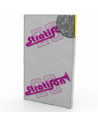
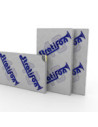
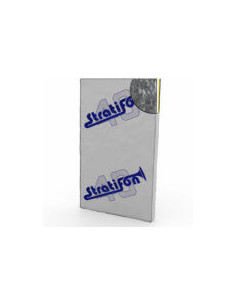
Stratifon panels combine the power of sound insulation with the versatility of sound absorption. Thanks to the mass-spring-mass layering, Stratifon 29 achieves 29 dB of panel insulation and up to 59 dB when paired with double drywall; all with a thickness of only 3.5 cm. It is stable, odourless, and easy to install even in tight spaces and hospitality structures.
For more demanding projects, Stratifon 40 offers 40 dB of certified insulation, reaching 61 dB with a double layer of drywall, thanks to a self-supporting 7 cm structure that combines sound impedance and absorption. It is self-supporting up to 5 m, resists mould and humidity, and allows the construction of lining walls and sound-insulated booths without sacrificing living comfort. Both panels are certified according to UNI EN ISO 10140-2.
Choosing between sound-insulating and sound-absorbing panels is not a matter of taste but of function. The former prevent sound from crossing structures and require dense materials and careful installation. The latter improve internal acoustics and rely on porous, lightweight materials. Often the ideal solution is to combine insulation and absorption through sandwich panels that leverage the properties of both
Before purchasing, analyse the problem (external noise, reverberation, or both), assess the space, and choose suitable materials. For those seeking an effective, certified, and easy-to-install solution, Stratifon 29 and Stratifon 40 offer the right balance of reduced thickness, high insulation, and decorative sound absorption, very useful also for those living near airports who want to eliminate the noise from arriving and departing aircraft.
With a well-designed system and professional installation, any room can be transformed into a quieter, more comfortable, and more pleasant place to live.
Comments (0)