

Shopping Cart
- Simone
- News
- 0 likes
- 1474 views
- 0 comments
Creating an acoustically isolated room inside a home is an increasingly common need: smart working, music, home cinema, gaming rooms, bedrooms exposed to traffic or noisy neighbors. In these cases, acting on a single surface is not enough; a global and integrated approach is required, addressing walls, ceiling, floor, and structural weak points. This guide explains how to correctly design the acoustic insulation of a room and which solutions to adopt to achieve real and measurable results.
When it really makes sense to soundproof a room
- Continuous or impulsive noise coming from multiple directions (neighbors, street, commercial activities).
- Intensive room use: music studio, rehearsal room, home cinema, gaming room, smart working.
- Need for acoustic privacy in bedrooms, professional offices, or healthcare environments.
- Lightweight buildings with thin walls and low-mass floor slabs.
In these situations, a partial intervention only provides limited benefits. Effective soundproofing requires controlling all involved surfaces.
The key principle: the “room within a room”
The most effective method for soundproofing a room is the room within a room concept: an independent internal structure that does not transmit vibrations to the original building structure.
- Mass: heavy surfaces that hinder sound transmission.
- Decoupling: absence of rigid connections with existing walls, ceiling, and floor.
- Internal absorption: fibrous materials that dampen resonances.
- Airtightness: no gaps, holes, or unsealed passages.
Wall soundproofing
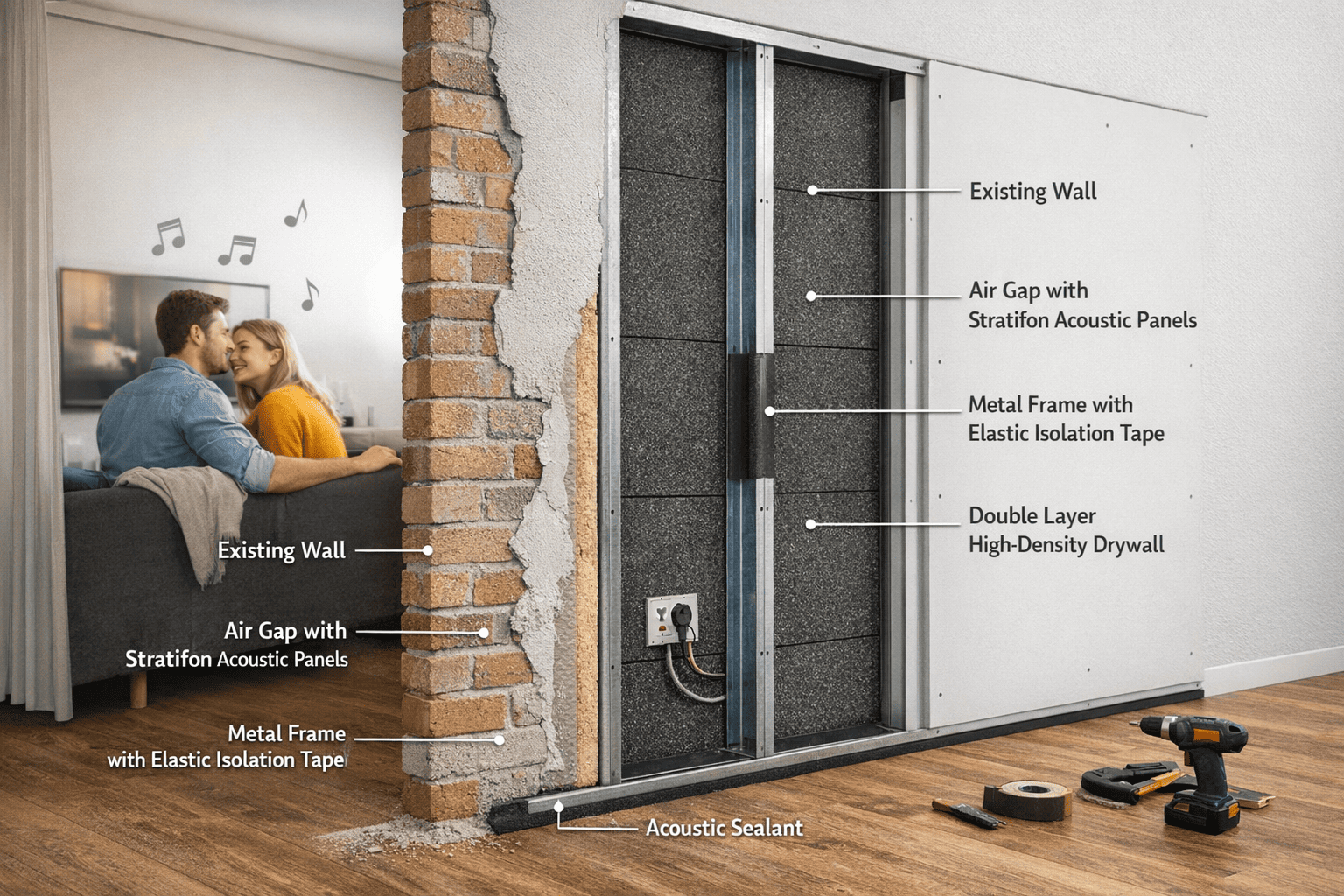
Walls are often the main path for noise transmission. The most effective solution is an acoustic lining wall:
- Decoupled metal or self-supporting structure.
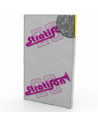
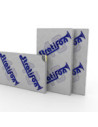
- High-mass, sound-blocking panels such as Stratifon 29 or Stratifon 40.
- Cavity filled with sound-absorbing material.
- Double layer of high-density plasterboard with staggered joints.
This build-up allows a significant reduction of airborne noise coming from outside the room.
Ceiling soundproofing
If noise comes from above or the room borders another housing unit, the ceiling becomes critical. The ideal solution is an elastic mass-spring-mass suspended ceiling:
- Anti-vibration hangers for decoupling.
- High-mass Stratifon panels.
- Absorbing material inside the cavity.
- Double sound-insulating closing layer.
This system reduces both impact noise and airborne noise.
Floor soundproofing
When possible, a floating floor completes the isolated shell:
- Continuous resilient underlay with perimeter upstands.
- High-mass screed or dry system.
- No rigid contact with the walls.
If intervention from above is not possible, the combined action on walls and ceiling still provides a significant improvement.
Critical points not to be underestimated
- Doors. A standard door cancels the insulation: soundproof doors or double doors are required.
- Windows. Double or triple glazing with airtight frames.
- Sockets and systems. Elastic seals and dedicated acoustic boxes.
- Perimeter joints. Always elastic, never rigid.
Common mistakes
- Soundproofing only one wall and expecting to solve the problem.
- Using only decorative sound-absorbing panels.
- Creating rigid connections between the new structure and existing masonry.
- Neglecting doors, windows, and electrical outlets.
- Underestimating the required mass.
Which Stratifon system to choose
- Stratifon 29: ideal for domestic rooms with limited space and moderate noise.
- Stratifon 40: recommended for rooms with high acoustic criticality, music, gaming, home cinema, and professional environments.
Both allow modular, certified, high-performance solutions.
Conclusions
Soundproofing a room does not mean applying a single product, but designing a coherent system that combines mass, decoupling, and absorption. Stratifon solutions make it possible to create truly quiet environments, improving comfort, privacy, and quality of life. With proper design and careful installation, the result is concrete, perceptible, and long-lasting.
Comments (0)