


Shopping Cart
- Simone
- News
- 1 likes
- 1377 views
- 0 comments
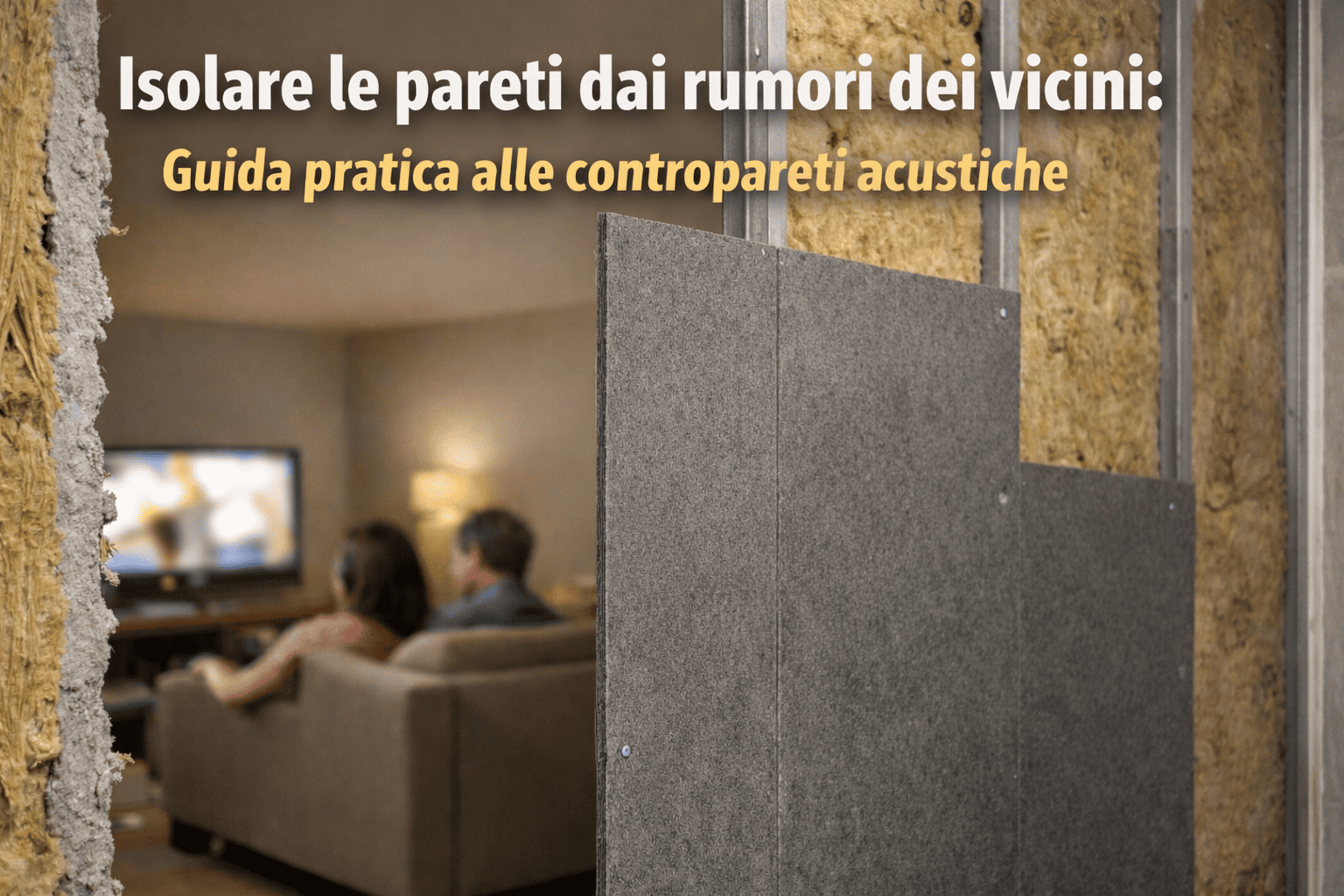
Noises coming from the adjacent apartment – voices, television, music, impulsive sounds – are among the most common causes of discomfort in apartment buildings. Even when the masonry seems “massive”, vibrations and sound waves find alternative paths through lightweight walls, service chases, and structural joints. In many cases, the most effective solution is not to intervene on the existing wall, but to create an independent soundproof partition wall, based on the mass–spring–mass principle and on high-performance panels such as the Stratifon systems.
Why sound still passes through walls
- Light or irregular masonry. Hollow blocks, thin partitions, and discontinuous plaster offer little resistance to sound transmission.
- Flanking transmission paths. Even with a massive wall, noise can bypass the obstacle and propagate through floors, perpendicular walls, pillars, and false ceilings.
- Services and chases. Chiselling for pipes, electrical boxes, service shafts, and other discontinuities drastically reduce acoustic insulation.
- Rigid joints. Direct structural connections (continuous plaster, rigid corner finishing) facilitate vibration transmission.
To achieve a noticeable and measurable improvement, increasing plaster thickness is not enough: it is necessary to decouple the new finishing layer from the existing wall with a stratified system.
Why acoustic panels and paints are not enough
Decorative acoustic panels, heavy curtains, and bookshelves can slightly improve indoor acoustic comfort by reducing reverberation, but they do not significantly increase the insulation between two rooms. Neighbours’ noise will still pass through the structure. To effectively block sound, you need to combine:
- Mass: dense, heavy materials that hinder the passage of sound waves.
- Spring: elastic or fibrous layers that decouple and absorb vibrations.
- Airtightness: absence of gaps, holes, and uncontrolled rigid connections.
What a mass–spring–mass partition wall is
An acoustic partition wall is a new internal wall installed in front of the existing one, separated by an air cavity and a sound-absorbing layer. The most effective version is the mass–spring–mass type:
- First mass: the existing wall (masonry or plasterboard).
- Spring: the cavity with sound-absorbing panels and air, which dampens vibrations.
- Second mass: the two plasterboard sheets, high-density boards, or wooden boards.
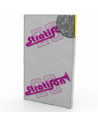
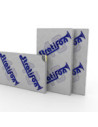
By integrating an advanced acoustic panel such as Stratifon into this scheme, you benefit from the combined effect of mass, spring, and sound absorption, achieving high performance with limited thickness.
Typical stratigraphy with Stratifon panels
1. Supporting structure
- T-profiles or self-supporting frames fixed to the floor and ceiling, with suitable elastic gaskets to separate them from the existing structure.
- Distance from the original wall calibrated according to the thickness of the Stratifon panel and any additional layers.
2. Installation of Stratifon acoustic panels
- Stratifon 29 for reduced-thickness applications requiring excellent performance with only 3.5 cm of panel.
- Stratifon 40 for highly performing, self-supporting partition walls suitable for critical situations (adjacent bedrooms, noisy rooms, music studios).
- The panels are fixed to the structure, placed edge-to-edge with no gaps, with carefully sealed joints.
3. Closure with high-mass boards
- Double layer of acoustic plasterboard or high-density gypsum board screwed to the structure.
- Staggered joints between the first and second boards to avoid acoustic bridges.
- Elastic perimeter joint between the partition wall and adjacent elements (floor slab, perpendicular walls, frames).
Installation phases of an acoustic partition wall
1. Preliminary analysis
- Identify the main noise source (voices, music, mechanical services, traffic).
- Check the available thickness and obstructions (sockets, radiators, windows).
- Assess flanking transmission paths through adjacent walls, ceiling, and floor.
2. Substrate preparation
- Check and restore any plaster detachments or large cavities.
- Seal unused holes and passages to improve airtightness of the existing wall.
3. Structure installation
- Fix guide profiles on floor and ceiling using elastic gaskets or decoupling tapes.
- Position vertical studs at a variable spacing (typically 40–60 cm), checking alignment.
4. Installation of Stratifon panels
- Cut panels to size, avoiding gaps and discontinuities.
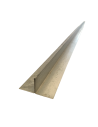
- Fix them to the special T-studs produced to avoid acoustic bridges, available exclusively at www.stratifon.it
- Seal joints with foam or elastic sealants where required by the system.
5. Closure and finishing
- Apply the first board of standard or high-density plasterboard, or wood, leaving a small perimeter gap from adjacent walls.
- Overlap the second board with staggered jo
Comments (0)