
Shopping Cart
- Simone
- News
- 0 likes
- 3969 views
- 0 comments
1. What are sound-absorbing panels and what are they for?
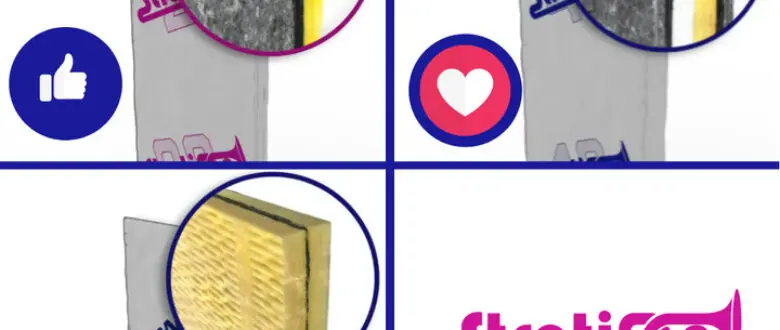
Sound-absorbing panels are elements designed to absorb the sound energy that propagates in an environment, particularly reducing the phenomenon of reverberation. Unlike soundproof panels, which prevent sound from passing between different rooms, sound-absorbing panels act within the same environment, improving listening quality and acoustic comfort.
These products are used in homes, offices, recording studios, theaters, schools, and restaurants—that is, in all contexts where it is important to prevent sound from bouncing uncontrollably on hard surfaces such as walls, glass, floors, and ceilings.
2. The sound absorption coefficient and performance classes
The acoustic performance of a sound-absorbing panel is expressed through the sound absorption coefficient α, which ranges from 0 (no absorption) to 1 (total absorption). To simplify the classification of materials based on their effectiveness, the UNI EN ISO 11654 standard introduces classes:
| Class | Average α Coefficient | Performance |
|---|---|---|
| A | 0.90–1.00 | Excellent |
| B | 0.80–0.90 | Very good |
| C | 0.60–0.80 | Good |
| D | 0.30–0.60 | Acceptable |
| E | 0.15–0.30 | Low |
For contexts such as recording studios, school classrooms, restaurants, and open-space environments, it is advisable to use materials with Class A or B absorption.
3. Thickness, materials and frequency response
The effectiveness of the panel varies according to the sound frequency to be absorbed. Low frequencies (50–250 Hz), such as those generated by machinery or traffic, require thick materials or the use of specific elements such as bass traps, to be placed in the corners of the room. Mid-high frequencies (500–4000 Hz), such as the human voice, can be effectively managed even with thinner panels.
Commonly used materials include:
-
Rock wool or glass fiber: excellent sound absorption performance, fire resistance and good dimensional stability.
-
Recycled polyester: ecological, stable, non-toxic material, also suitable for school or healthcare environments.
-
Perforated or micro-perforated wooden panels: combine aesthetics and acoustic function, widely used in auditoriums or conference halls.
The choice of material also depends on aesthetic needs, fire safety (reaction to fire classes), maintenance and environmental sustainability.
4. Regulatory references and legal obligations
Italian legislation on acoustic insulation and treatment is based on:
-
Framework Law No. 447 of 26 October 1995: defines the competences and intervention tools against noise pollution.
-
DPCM 5 December 1997: establishes the passive acoustic requirements of buildings, with limit values relating to airborne noise insulation, impact noise and plant noise.
-
UNI EN ISO 11654: classifies absorbent materials based on their effectiveness.
-
UNI 11367: defines the acoustic classification of buildings from Class I (very high performance) to Class IV (minimum level).
Since 2011, for new buildings or those undergoing major renovations, it is mandatory to obtain an acoustic certification issued by a qualified technician in environmental acoustics.
5. Installation: where and how to install the panels
The effectiveness of the treatment depends not only on the type of panel, but also on its position and installation method. Sound-absorbing panels can be wall-mounted, suspended from the ceiling or integrated into false ceilings. It is important to distribute them evenly to avoid “untreated” areas.
For low frequencies, it is advisable to also intervene in the corners, where sound waves tend to accumulate. In large or highly reflective environments, it may be useful to combine different materials to cover a wide range of frequencies.
6. How much do sound-absorbing panels cost?
The price of sound-absorbing panels varies according to:
-
Material and certifications
-
Thickness and format
-
Surface finish (fabric, paint, graphic printing)
-
Ordered quantity
Indicatively, a standard polyester panel can cost from 25 to 50 €/m², while customized, aesthetic or high-performance solutions can exceed 100 €/m². To these must be added design and installation costs.
7. Tax benefits
Currently, there are no specific incentives dedicated to acoustic treatment, unless the intervention is included in building renovation works. In these cases, it is possible to benefit from a 50% tax deduction on the expenses incurred, in compliance with the requirements established by the Consolidated Building Act (DPR 380/2001) and tax regulations (art. 16-bis TUIR).
To access the benefits, it is advisable to rely on a qualified technician who certifies the intervention.
8. Professional opinions
According to many industry professionals, the most common mistake is underestimating acoustic design. DIY interventions or uncertified products may be useless or worsen the situation. It is therefore always advisable to consult a competent environmental acoustics technician, capable of carrying out sound level measurements and dimensioning the intervention according to the objectives.
Even among architects and interior designers, there is increasing attention to acoustic quality, especially in open-space environments, showrooms and commercial spaces.
9. Frequently asked questions
Do sound-absorbing panels eliminate noise between rooms?
No. Sound-absorbing panels improve internal acoustics but do not block sound transmission between environments. For this, proper sound insulation is required.
Can I install them myself?
Yes, in many cases it is possible. However, for technical environments or large surfaces, it is better to rely on expert installers.
How long does it take to see the benefits?
Improvements are immediate: once correctly installed, the panels immediately modify the acoustic response of the environment.
Conclusion
Choosing the right sound-absorbing panel significantly improves residential or work comfort, acting in a targeted way on acoustic quality. It is essential not to rely solely on aesthetics or price, but to carefully evaluate technical parameters, certifications, and the specific needs of the environment.
To achieve an effective result, the advice remains the same: rely on qualified professionals, especially in the presence of regulatory constraints or complex acoustic requirements.
Comments (0)