


Shopping Cart
- Simone
- News
- 0 likes
- 645 views
- 0 comments
Acoustic insulation and fire safety: two different performances that must coexist
In the professional acoustic insulation sector, the choice of materials cannot be limited to noise reduction; every soundproofing system must properly comply with current fire safety regulations.
More and more often, designers of high-performance acoustic partition walls face generic requests such as “materials in class A1 or A2”, but in the context of dry acoustic insulation systems, it is essential to distinguish between the reaction to fire of the sound-insulating material and the fire resistance of the wall as a whole.
Confusing these two aspects means not understanding how a certified soundproofing stratigraphy actually works.
Fire behaviour of the acoustic insulation panel
Reaction to fire classifies the behaviour of a single material when it is directly exposed to a fire source; this is an important assessment, especially when working in public environments or in buildings subject to specific safety requirements.
In the case of acoustic insulation panels, reaction to fire indicates how much the material contributes to combustion and its intrinsic level of safety. However, in dry soundproofing systems, the panel placed in the cavity is normally not the exposed surface. The first barrier to fire is provided by the cladding boards and the wall configuration.
The acoustic panel mainly performs a function of dissipating sound energy and damping vibrations, not a structural function of directly containing flames.
Fire resistance in high-performance acoustic walls
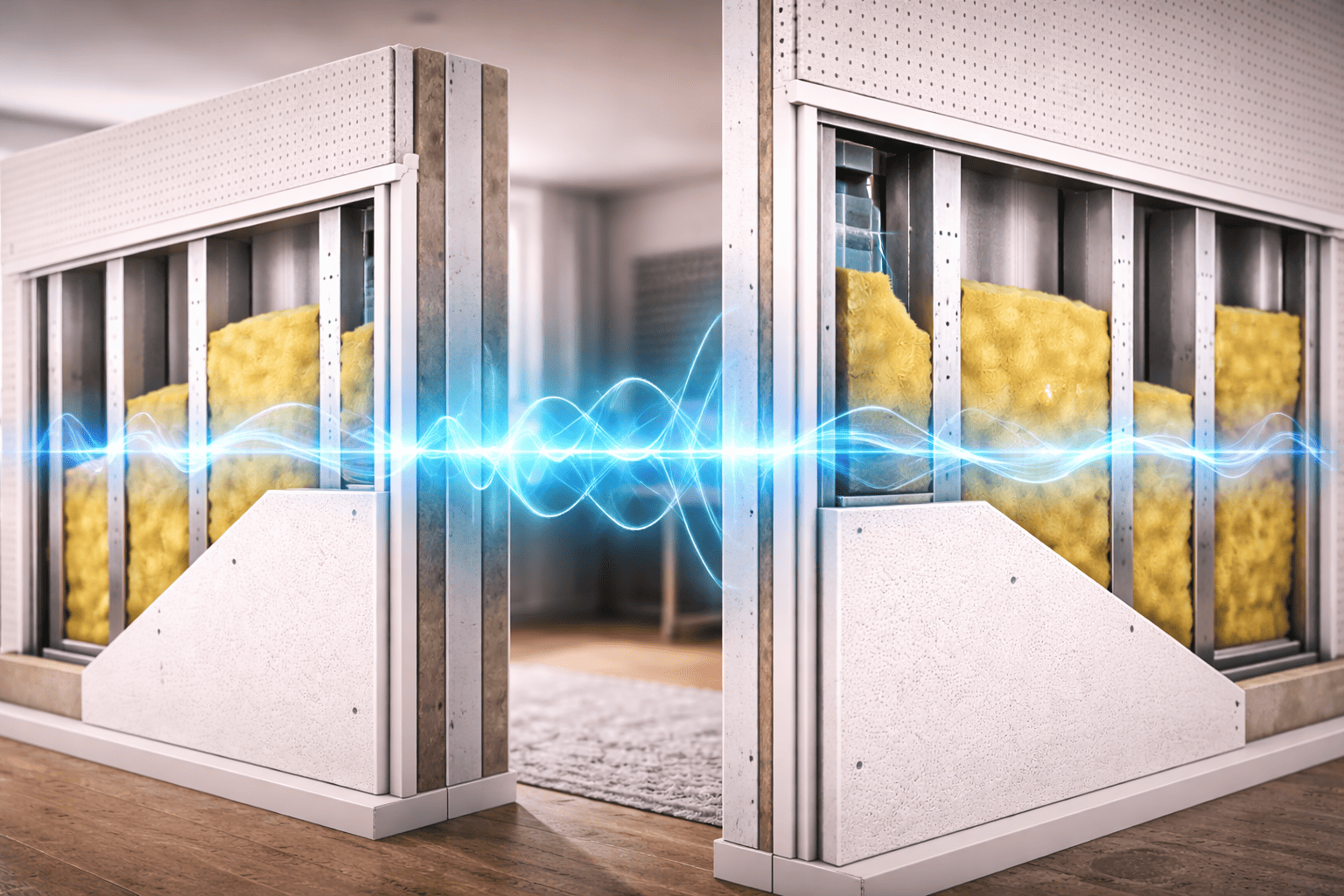
Fire resistance, classified as REI 60, REI 90 or higher, concerns the entire construction element; it does not depend on a single component but on the combination of metal structure, number of boards, thicknesses, joints, and the material placed in the cavity.
In the case of soundproof walls, design is already oriented toward maximizing mass, decoupling, and internal absorption. This type of configuration, if correctly tested, can achieve high performance both acoustically and in terms of fire resistance.
However, it is the laboratory test on the entire system that determines the REI classification, not just the reaction-to-fire class of the acoustic panel.
This concept is central: certification belongs to the wall in its real configuration, not to the single layer.
Acoustic performance and fire behaviour: technical balance
An effective soundproofing system works on three fundamental principles: mass, elasticity, and internal absorption. The panel placed in the cavity helps reduce airborne noise transmission and damp structural vibrations.
From a fire safety perspective, its presence can contribute to the thermal stability of the stratigraphy, but it does not replace the function of protective boards nor that of the load-bearing structure.
Designing acoustic insulation without considering fire behaviour is a mistake. But designing fire safety while ignoring the real function of the sound-insulating material is equally wrong.
The two performances must coexist within a certified and coherent system.
The most common mistake: isolating the component from the system
In the acoustic insulation sector, it often happens that people ask whether the sound-insulating panel is “REI certified”. The question itself is technically inaccurate.
A panel can be classified for reaction to fire, but REI resistance is a characteristic of the complete construction element.
The wall is made up of structure, claddings, and sound-insulating material; this combination is what is tested.
If one of the layers is modified, compatibility with the certified configuration must be verified. It is not enough for the single material to have a good reaction-to-fire class to automatically guarantee a wall resistant to fire for 60 or 90 minutes.
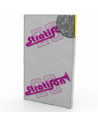
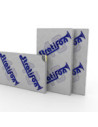
The key point for those choosing Stratifon solutions
When choosing a system for professional acoustic insulation, the evaluation must be global.
The sound-insulating panel is decisive for:
- improving acoustic reduction
- reducing vibrations
- increasing comfort between adjacent rooms
Fire safety, on the other hand, is linked to the certification of the entire construction package.
The correct question is not whether the panel is REI, but whether the wall built with that specific configuration has been tested and certified.
Understanding this distinction makes it possible to design high-performance, safe, and regulation-compliant soundproofing systems, without simplifications that risk compromising the technical balance of the stratigraphy.
Conclusion
In the world of professional acoustic insulation, the quality of a system is not measured only in decibels reduced, but also in its integration with safety requirements.
Reaction to fire and fire resistance are not synonyms. They are two distinct parameters operating at different levels.
The sound-insulating panel contributes to acoustic performance and to the overall behaviour of the system, but it is the complete wall that determines the REI classification.
And it is on this balance between acoustic comfort and safety that a truly professional project is built.
Comments (0)